


What Does Workers’ Compensation Cover in Utah?
If you were injured on the job or developed an illness caused by your work in Utah, workers’ compensation covers 100% of your reasonable and necessary medical treatment, replacement for a portion of your lost wages, payments for permanent impairment, and vocational rehabilitation support.
Utah workers’ compensation is a no-fault insurance system governed by the Utah Workers’ Compensation Act (Utah Code Ann. § 34A-2-101 et seq.). This means you do not have to prove your employer was careless or negligent to receive benefits. If the injury occurred “out of and in the course of” your employment, you are entitled to statutory coverage.
However, workers’ compensation does not cover everything. It does not pay for non-economic damages like “pain and suffering,” nor does it cover injuries resulting from intentional self-harm or active drug or alcohol intoxication on the job.
Below is a detailed breakdown of every primary benefit category provided under Utah law.
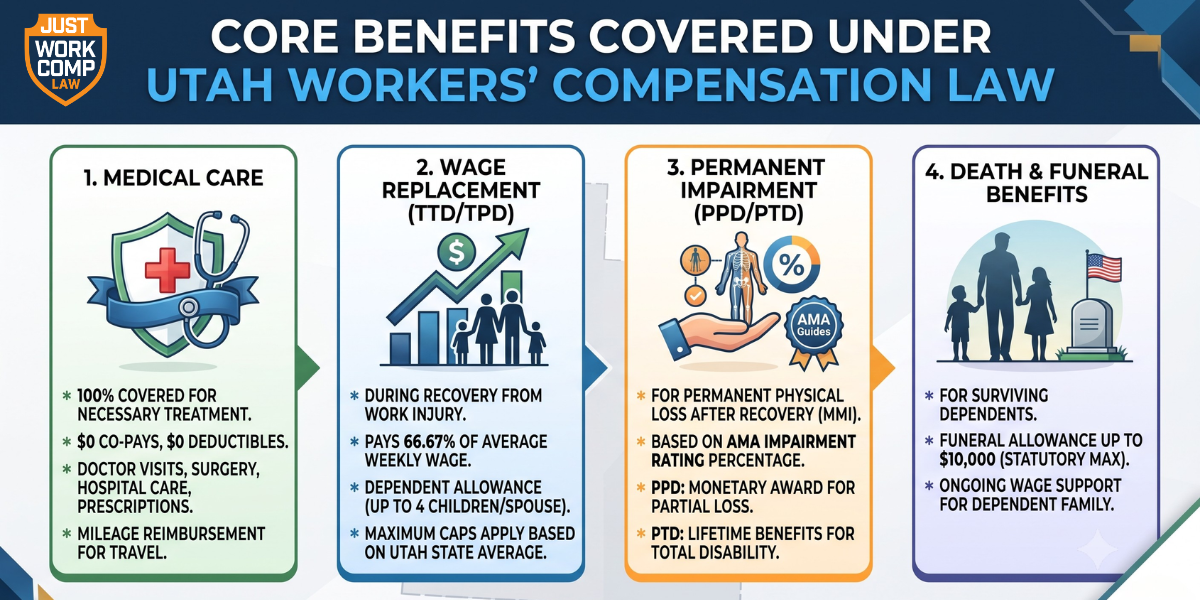
Quick Summary: The Core Workers’ Comp Benefits in Utah
Utah law categorizes workers’ compensation benefits into four main areas:
| Benefit Category | What Utah Law Covers | Key Detail / Calculation |
| Medical Benefits | 100% of reasonable, necessary medical care | No copays or deductibles for authorized care; includes mileage reimbursement. |
| Temporary Disability | Partial replacement of lost wages during recovery | 66.67% of pre-injury average weekly wage plus $20/week per dependent (up to 4 dependents). |
| Permanent Impairment | Compensation for permanent physical loss | Based on an AMA impairment rating once you reach Maximum Medical Improvement (MMI). |
| Death Benefits | Support for surviving dependents after fatal accidents | Funeral expense allowance up to statutory caps plus ongoing wage replacement benefits. |
Medical Benefits: 100% Coverage for Necessary Treatment
Under Utah Code § 34A-2-418, your employer’s workers’ compensation insurance carrier must pay for all reasonable and necessary medical treatment directly related to your work injury.
Unlike regular private health insurance, there are no deductibles, no co-pays, and no out-of-pocket costs for covered medical care.
What Medical Expenses Are Covered?
- Emergency room care and ambulance transportation.
- Doctor visits and specialist consultations.
- Surgical procedures and hospital stays.
- Prescription medications ordered for the injury.
- Physical therapy, chiropractic care, and occupational therapy.
- Diagnostic imaging (X-rays, MRIs, CT scans).
- Prosthetic devices, crutches, braces, and medical equipment.
Travel and Mileage Reimbursement
Utah administrative rules require the insurance carrier to reimburse you for travel expenses incurred while traveling to and from authorized medical appointments, pharmacy visits, and therapy sessions. Keep a detailed log of your travel dates, facility addresses, and round-trip mileage.
Choosing Your Doctor in Utah
Under Utah administrative rules, your employer or their insurance carrier has the right to designate the initial medical provider for your first visit. However, after that initial visit, Utah law grants you the right to make one free change of treating physician without requiring insurance company approval, provided you notify the insurer.
The ability to choose your own doctor is perhaps the best kept secret in Utah workers’ comp cases. Insurance adjusters will often try and steer people away from choosing another doctor by telling them that they have to see “in-network” doctors. This is so people will continue to see doctors that will reliably benefit the insurance company by putting people back to work before they are medically ready thereby saving the insurance company money. It’s important that injured workers are treated by doctors that they like and trust. Doctors are the single most important people in workers’ compensation cases because it is their professional opinions that shape a case.
Wage Loss Benefits: How Utah Calculates Disability Pay
When a doctor certifies that your work injury prevents you from working, or limits the hours/tasks you can perform, Utah workers’ compensation provides indemnity (wage-replacement) benefits.
Temporary Total Disability (TTD)
If your treating doctor states you cannot work at all during your recovery, you qualify for Temporary Total Disability (TTD) under Utah Code § 34A-2-410.
- Standard Rate: TTD pays 66.67% (two-thirds) of your pre-injury Average Weekly Wage (AWW).
- Dependent Allowance: Utah adds $20 per week for a dependent spouse and $20 per week for each dependent child under age 18 (up to a maximum of 4 dependents, or $80 extra per week).
- Maximum Limit: Your weekly benefit cannot exceed 100% of the State Average Weekly Wage (SAWW) established for the year of your injury.
Temporary Partial Disability (TPD)
If you return to light-duty or modified work that pays less than your pre-injury earnings, you qualify for Temporary Partial Disability (TPD) under Utah Code § 34A-2-411.
TPD pays 66.67% of the difference between what you earned before the injury and what you are earning while on light duty.
The 3-Day Waiting Period Explained
Under Utah law, wage loss benefits are not paid for the first 3 calendar days of work missed. However, if your disability keeps you off work for 14 consecutive days or more, the insurance company must retroactively pay you for those initial 3 days.
Special Note: Temporary Total Disability should account for both overtime worked prior to the injury AND wages you earned from a second job if you had one at the time of injury. If a person was working regular overtime prior to a work injury meaning they regularly worked 46 hours per week instead of just 40 hours per week, the insurance adjuster needs to take the overtime hours in to account when calculating the amount of temporary total disability payments.
Permanent Disability and Impairment Benefits
Once your treating physician determines you have reached Maximum Medical Improvement (MMI)—meaning your condition has stabilized and further medical treatment is not expected to significantly improve your function—you will be evaluated for permanent impairment.
Permanent Partial Disability (PPD)
If your work injury leaves permanent physical damage (such as permanent loss of mobility, spinal disc herniation, or joint damage), you may receive Permanent Partial Disability (PPD) benefits under Utah Code § 34A-2-412.
- A medical evaluator uses the American Medical Association (AMA) Guides to the Evaluation of Permanent Impairment to assign an impairment rating percentage.
- Utah statute outlines a specific schedule of weeks paid based on the injured body part (e.g., loss of a finger vs. back injury).
- PPD checks are calculated using a statutory weekly base rate set by state law for the year of injury.
Permanent Total Disability (PTD)
If your injury is so severe that you are permanently unable to perform any gainful employment in the open labor market, you may be eligible for Permanent Total Disability (PTD) under Utah Code § 34A-2-413.
PTD claims involve an evidentiary process before the Utah Labor Commission to prove that no reasonably stable labor market exists for your remaining physical capabilities, age, education, and work experience.
Death and Funeral Benefits for Surviving Dependents
If a workplace accident or occupational illness leads to a fatal injury, Utah Code § 34A-2-414 provides benefits to surviving dependents:
- Funeral Expenses: Coverage for burial and funeral expenses up to the statutory maximum allowance (currently up to $10,000).
- Dependent Wage Replacement: Ongoing weekly monetary benefits paid to a surviving spouse and dependent children based on the deceased worker’s Average Weekly Wage.
What Does Utah Workers’ Compensation NOT Cover?
While Utah workers’ compensation provides important protections, it does not cover every expense or scenario:
- Pain and Suffering: You cannot recover non-economic compensation for physical pain, emotional distress, or loss of enjoyment of life under workers’ comp.
- Full Wage Replacement: Benefits cap out at two-thirds of your average weekly wage (subject to state statutory maximums), not 100% of your earnings.
- Intentional Self-Inflicted Injury: Injuries caused deliberately by the employee are barred from coverage.
- Intoxication or Drug Use: If an injury is caused by employee intoxication or unauthorized drug use, benefits may be denied or substantially reduced under Utah law.
- Off-Duty / Non-Work Activities: Injuries that occur during social events, recreational activities, or standard commutes (“going and coming rule”) are generally excluded unless a specific exception applies.
What to Do If the Insurance Company Denies Your Coverage
Insurance carriers often deny valid Utah workers’ compensation claims by arguing that the injury was pre-existing, occurred off the job, or did not receive timely notice.
If your claim or a specific medical procedure is denied, you have the right to file an Application for Hearing with the Utah Labor Commission’s Adjudication Division.
Frequently Asked Questions About Utah Workers’ Comp Coverage
Does Utah workers’ comp cover pre-existing conditions?
Yes, if your job duties or an acute workplace accident medically aggravated, accelerated, or worsened a pre-existing condition beyond its normal natural progression, the resulting disability and medical treatment are covered under Utah law.
Does workers’ comp cover wage loss if I am placed on light duty but my employer has no work for me?
Yes. If your doctor releases you to light-duty work with physical restrictions, but your employer cannot accommodate those restrictions, you remain eligible to receive Temporary Total Disability (TTD) wage benefits.
Can I be fired for filing a workers’ compensation claim in Utah?
Utah is an at-will employment state, but it is illegal for an employer to retaliate against you solely for exercising your legal right to file a workers’ compensation claim.
This article provides general information about Utah workers’ compensation law. It is not legal advice and does not create an attorney-client relationship. Workers’ compensation outcomes depend on the specific facts of each case and the law in effect at the relevant time. Contact a Utah workers’ compensation attorney to discuss your specific case.
Related Articles
- What does workers compensation not cover in Utah?
- Reporting Your Workplace Injury to Your Employer in Utah
- Utah Workers’ Compensation Guide to Benefits
- Utah Workers’ Comp Denied? 6 Reasons & How to Appeal
- A Crash Course In Utah’s Lost Wage Compensation Laws
Injured on the job? Learn how our team handles Utah work injury claims, or request a free consultation.
Hal Davis
Zero out-of-pocket costs, compassionate advocacy, and down-to-earth legal honesty. Our team is dedicated to protecting the rights of hard-working individuals across Utah. Our team provides clear, straightforward guidance throughout every step of your claim—fully backed by bilingual support so language is never a barrier to achieving justice.
*The information provided on this website does not, and is not intended to, constitute legal advice; instead, all information, content, and materials available on this site are for general informational purposes only.