


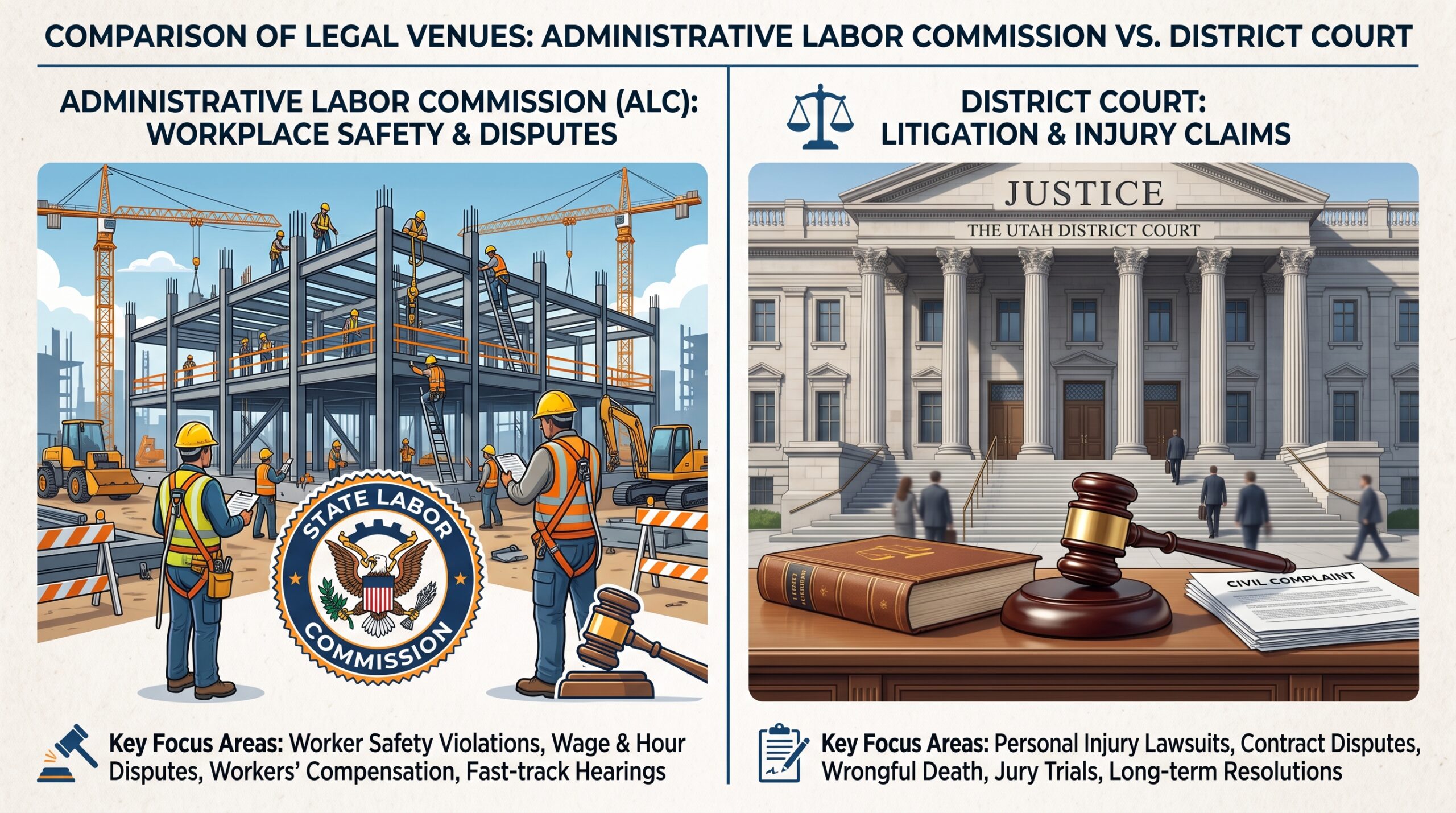
What Is the Difference Between a Workers’ Compensation Claim and a Personal Injury Claim in Utah?
If you were injured on the job in Utah, you may be wondering what type of legal claim you need to file, whether you can sue your employer, and how your medical bills and lost wages will be covered.
Under Utah law, a workers’ compensation claim and a personal injury claim are two completely separate legal remedies with different rules, benefits, and proof requirements:
Workers’ Compensation Claims are no-fault administrative claims filed through the Utah Labor Commission system. You do not have to prove your employer was negligent, but benefits are strictly limited to necessary medical treatment, partial wage replacement, and statutory disability payments. You cannot receive compensation for pain and suffering.
Personal Injury Claims are civil lawsuits filed in Utah District Court against a negligent party (other than your employer or co-worker). You must prove fault, but you can recover full financial damages, including 100% of lost earnings, future lost earning capacity, and physical pain and suffering.
Understanding how these two systems operate—and when they overlap—is critical to protecting your health and financial recovery after a workplace accident.
At a Glance: Utah Workers’ Compensation vs. Personal Injury Lawsuits
| Feature | Utah Workers’ Compensation Claim | Utah Personal Injury Lawsuit |
| Primary Governing Authority | Utah Labor Commission / Utah Code Title 34A | Utah District Courts / Utah Civil Code |
| Fault Requirement | No-Fault System. Benefits apply even if the accident was caused by your own minor mistake or an employer error. | Fault-Based. You must prove another party was negligent or intentionally at fault. |
| Right to Sue Employer | Barred. Utah’s “Exclusive Remedy” rule prevents you from suing your employer in court. | Allowed against negligent third parties (contractors, drivers, equipment makers), but not your direct employer. |
| Pain & Suffering | Not Available. | Available. Covers physical pain, emotional distress, and reduced quality of life. |
| Wage Benefits | Partial. Typically 66⅔% of your average weekly wage, capped by Utah’s annual statutory limits. | Full. 100% of past lost wages, future lost wages, and lost earning capacity. |
| Medical Coverage | 100% Covered. Pays all reasonable and necessary medical care related to the work injury without copays or deductibles. | Damages Recovered Post-Case. You pay or bill insurance upfront, then seek reimbursement through a lump-sum verdict or settlement. |
| Filing Deadline | Report injury to employer within 180 days; file formal claim at Labor Commission within 6 years. | Generally 4 years from the date of injury under Utah’s negligence statute of limitations. |
1. Fault and Liability Requirements Under Utah Law
The foundational difference between a workers’ compensation claim and a personal injury lawsuit lies in whether you must prove that someone else did something wrong.
Workers’ Compensation Is a No-Fault System
Under Utah’s Workers’ Compensation Act, you are entitled to benefits if your injury occurred “by accident arising out of and in the course of” your employment. You do not need to prove that your employer created an unsafe condition, violated safety codes, or acted carelessly. Even if your own accidental mistake contributed to the injury, you generally remain eligible for full statutory benefits.
Exceptions exist under Utah law: Benefits may be reduced or denied if an injury resulted from deliberate self-infliction, intoxication, or illegal drug use on the job.
Personal Injury Lawsuits Require Proof of Negligence
In contrast, a personal injury claim requires you to prove that a defendant owed you a duty of care, breached that duty through negligence or wrongful acts, and directly caused your injuries. If you cannot establish fault, you cannot recover damages in a civil court action.
2. Can You Sue Your Employer in Utah? (The Exclusive Remedy Rule)
Many injured employees assume that if an employer failed to fix a dangerous machine or maintain a safe job site, they can sue the employer for damages. In Utah, this is almost never permitted.
Under Utah Code § 34A-2-105, workers’ compensation is the exclusive remedy an employee has against their employer and co-workers for on-the-job injuries.
In exchange for guaranteed, no-fault medical and wage benefits, workers give up their right to sue their employer in court for personal injury damages.
The Extremely Narrow Exception
Utah courts recognize an exception to the exclusive remedy bar only when an employer commits an intentional tort—meaning the employer intentionally acted with the specific intent to injure the worker (see Clark v. Industrial Commission). Demonstrating gross negligence, severe OSHA violations, or willful safety neglect is generally insufficient under Utah law to bypass the exclusive remedy rule.
3. What Damages and Benefits Can You Recover?
The compensation structures for these two legal pathways differ significantly in scope and calculation.
Benefits Paid by Utah Workers’ Compensation
Workers’ compensation is designed to provide immediate, basic financial stability rather than complete tort damages. Benefits include:
Medical Expenses: Payment of all reasonable, necessary, and related medical treatment, surgeries, physical therapy, and prescription medications using statutory medical fee schedules.
Temporary Total Disability (TTD): Partial wage replacement—typically 66⅔% of your average weekly wage up to Utah’s state maximum—while a doctor keeps you off work entirely.
Temporary Partial Disability (TPD): Wage-loss compensation if you return to light-duty work that pays less than your pre-injury wage.
Permanent Partial Impairment (PPI): Compensation based on Utah’s statutory impairment schedules if your injury leaves permanent physical damage after reaching Maximum Medical Improvement (MMI).
Permanent Total Disability (PTD): Ongoing benefits if a severe workplace injury permanently prevents you from returning to any meaningful employment in the open labor market.
Damages Available in a Personal Injury Claim
Because personal injury claims are fault-based, the financial recovery is designed to make the injured victim completely whole. Compensatory damages include:
Full Past and Future Lost Wages: Recovery of 100% of lost income and unearned bonuses/benefits, plus future loss of earning capacity.
Non-Economic Damages: Financial recovery for physical pain, suffering, loss of enjoyment of life, physical disfigurement, and emotional trauma.
Full Future Medical Costs: Compensation for anticipated lifelong medical costs calculated at market value rather than administrative fee schedules.
4. When Workplace Accidents Involve Third Parties
While you cannot sue your direct employer or a fellow employee for a work injury, workplace accidents are frequently caused by negligent third parties. Under Utah Code § 34A-2-106, you have the legal right to pursue both a workers’ compensation claim and a third-party personal injury lawsuit simultaneously.
We have handled many cases where employees where injured in car accidents while making service calls or deliveries. We have focuses on the workers’ compensation case, while a personal injury attorney has handled the car accident claim. In these kinds of cases, coordination between the cases is important to provide the best outcome for the injured worker.
Common Examples of Third-Party Work Injury Claims in Utah
Motor Vehicle Collisions: You are hit by a negligent driver while driving a delivery vehicle, traveling between job sites, or running an errand for your employer.
Multi-Employer Construction Sites: You are injured on a job site by an employee working for a separate subcontractor or general contractor.
Defective Machinery or Equipment: You are hurt by a malfunctioning tool, ladder, or heavy machinery caused by a manufacturing defect or improper design.
Property Owner Negligence: You are injured on property owned by a third party due to hazardous conditions the owner failed to repair or warn you about.
How Dual Claims Interact (Subrogation Rights)
When you recover funds from a third-party personal injury settlement or court verdict, Utah law allows the workers’ compensation insurance carrier to assert a statutory lien against those funds to recover benefits they paid on your behalf. An experienced Utah attorney manages this subrogation process to reduce the insurance lien and maximize the net recovery in your pocket.
5. Procedural Differences and Deadlines
Navigating these claims requires adhering to strict, distinct administrative and judicial timelines in Utah.
Reporting and Claiming Workers’ Comp: You must notify your employer of a work accident within 180 days under Utah Code § 34A-2-407. If your claim is denied or unpaid, an Application for Hearing must be filed with the Utah Labor Commission Adjudication Division within 6 years of the accident date.
Filing a Personal Injury Lawsuit: General negligence claims in Utah must be filed in District Court within 4 years under Utah Code § 78B-2-307 (or 1 year if bringing a claim against certain government entities under the Utah Governmental Immunity Act).
Do You Need a Workers’ Compensation Attorney or a Personal Injury Attorney?
Because workers’ compensation and personal injury lawsuits involve vastly different courts, rules, and strategies, choosing an attorney who concentrates specifically on the legal framework governing your accident is essential.
If your injury occurred at work, you should consult an attorney who focuses on Utah workers’ compensation law. If a third party contributed to your injury, a firm that understands how to coordinate workers’ comp benefits alongside personal injury claims will help protect your rights under both legal systems.
When to Seek Legal Representation
You should speak with a dedicated Utah workers’ compensation lawyer immediately if:
Your employer or their insurance company denied your claim or refused medical treatment.
Your weekly disability benefits were calculated incorrectly or cut off prematurely.
An insurance company doctor claims you have reached Maximum Medical Improvement (MMI) while you are still in severe pain.
You are assigned an unfairly low permanent impairment rating.
Your injury was caused by a third party and you need to navigate both workers’ comp benefits and a third-party lawsuit.
Should You Choose a Personal Injury Lawyer or a Workers Compensation Lawyer?
When you’re hurt at work, you need an expert in workers compensation law—not an attorney who practices only personal injury law or a generalist who practices a dozen different branches of law.
The attorneys of Just Work Comp Law are workers comp experts, and we only handle workers comp cases. If you’re hurt at work and you’re not sure of the next step to take, give us a call ASAP—the longer you delay filing your claim, the higher risk you run of being denied benefits.
FAQ / FOLLOW-UP QUESTIONS
Can I receive pain and suffering from Utah workers’ compensation?
No. Utah workers’ compensation benefits are strictly defined by statute and only pay for necessary medical expenses, partial wage replacement (TTD/TPD), and permanent impairment ratings. Physical pain and suffering damages are only recoverable through a separate personal injury lawsuit against a negligent third party.
What if my work injury was caused by a co-worker?
Under Utah Code § 34A-2-105, the exclusive remedy rule applies to co-workers acting in the scope of employment. You generally cannot sue a fellow employee for negligence causing a work injury; your sole recourse against both your employer and co-worker is filing a workers’ compensation claim.
Can I file both a workers’ comp claim and a personal injury lawsuit in Utah?
Yes, if a third party (someone other than your employer or co-worker) caused or contributed to your work accident. For example, if you are rear-ended by a negligent driver while making deliveries for your job, you can receive workers’ comp benefits while simultaneously filing a personal injury lawsuit against the driver who hit you.
Last Reviewed / Updated on 09/30/2026 by Hal Davis
Related Articles
- Injury or Illness: Is There A Difference for Workers Comp?
- Reporting Your Workplace Injury to Your Employer in Utah
- What Does Workers’ Compensation Cover in Utah?
- Utah Workers’ Compensation Guide to Benefits
- Utah Workers’ Comp Denied? 6 Reasons & How to Appeal
Injured on the job? Learn how our team handles Utah work injury claims, or request a free consultation.
Hal Davis
Zero out-of-pocket costs, compassionate advocacy, and down-to-earth legal honesty. Our team is dedicated to protecting the rights of hard-working individuals across Utah. Our team provides clear, straightforward guidance throughout every step of your claim—fully backed by bilingual support so language is never a barrier to achieving justice.
*The information provided on this website does not, and is not intended to, constitute legal advice; instead, all information, content, and materials available on this site are for general informational purposes only.